


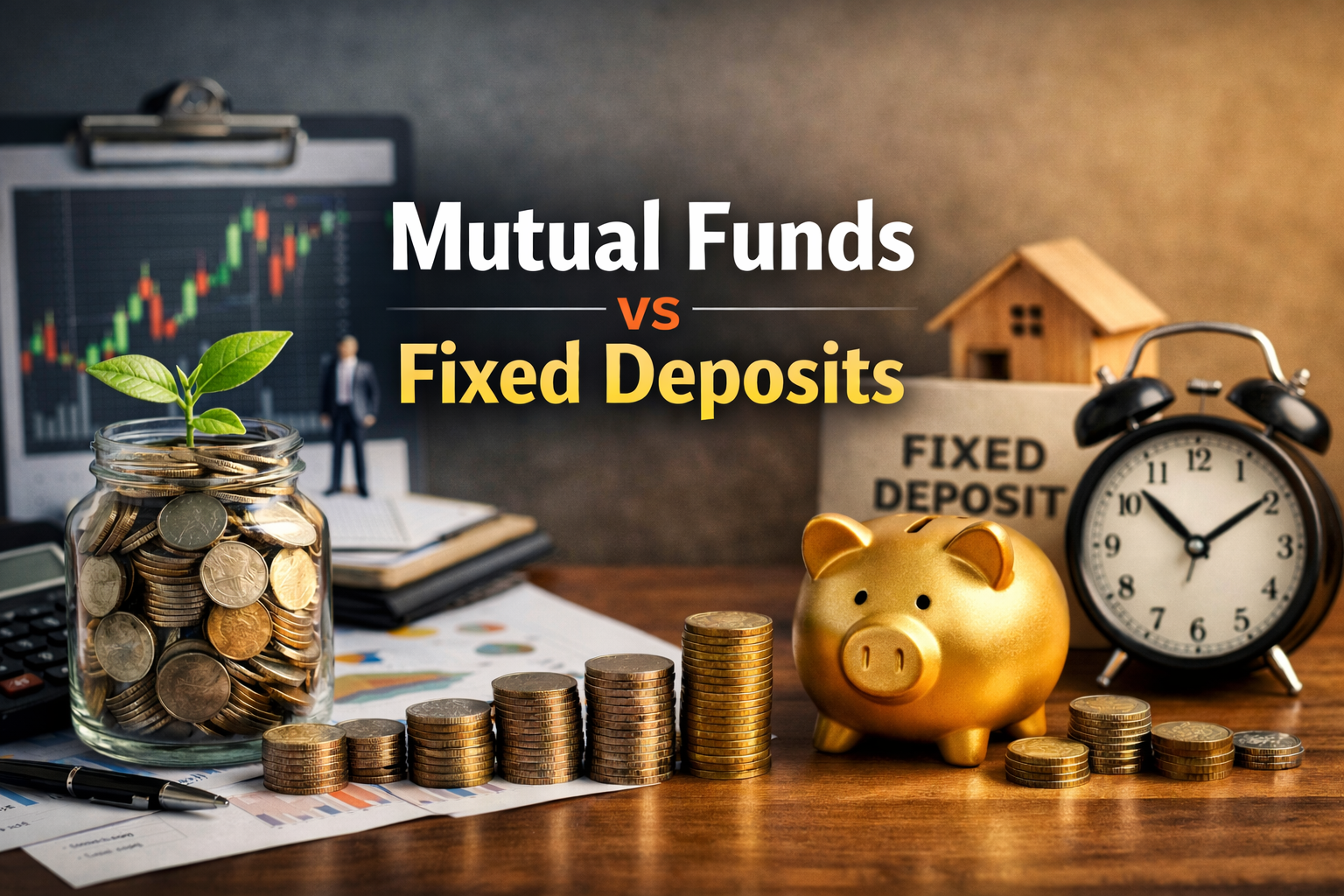
So, if you are from India, you would have noticed that your parents were fanatical about fixed deposits, whereas your friends, YouTube reels, and finance YouTubers have been repeating tirelessly, “Mutual funds sahi hai.”
Now you’re left between the two – the FDs make you feel safe, but the mutual funds seem to offer better returns.
Of course, several questions arise in your head:
“Can I really lose money in mutual funds?”
“Are FDs too slow to meet my goals?”
“So, what is the right pick for me with a starting amount of ₹1,000 or ₹5,000?”
Let’s break down the confusion and have a conversation about it, like talking to a financial sage, but not a lecture about finances.
What Exactly Are Fixed Deposits and Mutual Funds?
Fixed Deposits (FDs): The Safe-Feeling Option
FD is the classic Indian favorite.
You give your money to a bank or NBFC for some fixed period and they promise you a fixed rate of interest-no surprises, no charts, no market tension.
- You decide upon a term, say 1, 3, or 5 years.
- The interest rates are told upfront by the bank, say 6.5–7.5% per year depending on bank and tenure.
- At maturity, you get back your principal + interest.
The RBI regulates FDs, and eligible deposits are covered under deposit insurance up to a limit, for which reason families see them as “Safe” money.
Mutual Funds: Your Money in the Market (But Managed for You)
Mutual funds collect money from various investors and invest in stocks, bonds, or a combination of both through professional fund managers, and are regulated by SEBI.
- Equity funds are primarily invested in stocks.
- It invests in Bonds, Government securities, etc.
- These funds combine both.
Returns are market-linked. That is, they may fluctuate and may go down, but they may be able to offer a return greater than that of FDs if chosen wisely.
Mutual Funds vs Fixed Deposits: Quick Comparison
| Factor | Fixed Deposits (FDs) | Mutual Funds |
| Return type | Fixed, pre-declared interest rate | Market-linked, can go up or down |
| Risk | Low, bank/issuer risk and inflation risk | Varies: low (debt) to high (equity), market risk |
| Suitable for | Capital safety, short-term needs, emergency fund | Long-term wealth creation, beating inflation |
| Liquidity | Can withdraw early with penalty | Can redeem; subject to NAV and possible exit load |
| Minimum amount | Often from ₹1,000–₹5,000 | Capital gains tax, rate depends on type & holding period |
Returns: Guaranteed Comfort vs Growth Potential
How FDs Grow Your Money
With FDs, you know the interest rate at the time of booking.
Example (illustrative):
- You invest ₹1,00,000 in an FD for 5 years at 7% p.a.
- At the end, you roughly get around ₹1.4 lakh before tax.
It feels good because it’s predictable.
But there’s a catch: inflation. If inflation stays close to or above your FD rate, your real purchasing power barely grows.
How Mutual Funds Can Grow Faster (If You Give Them Time)
Equity and hybrid mutual funds can deliver higher returns over long periods (say 7–10+ years), but they will fluctuate in between.
Example (simplified and not guaranteed):
- ₹1,00,000 in a diversified equity fund for 10 years with, say, ~11–12% average annual return historically in some funds, can grow much more than a 7% FD.
But unlike FDs, this is not guaranteed. You must be ready to see ups and downs on the way.
Risk, Safety, and Sleep-at-Night Factor
Why FDs Feel Emotionally Safe
- Capital Stability: The principal amount is secure if the deposit is held until maturity.
- No Daily Volatility: Investors are spared from daily price fluctuations.
- Emotional Comfort: FDs are often trusted by older family members, providing psychological ease.
The Major Hidden Risk:
- Erosion of Wealth: The primary danger with FDs is that, after accounting for both inflation and taxes, the real growth of your money may be insufficient.
What Risk in Mutual Funds Actually Means
When you hear “mutual funds are subject to market risk”, it mainly means:
- NAV (price) goes up and down based on markets.
- In the short term, you can see negative returns.
- If you panic and exit at the wrong time, you may lock in losses.
But if you:
- choose the right type of fund for your horizon, and
- stay invested for long enough,
you reduce the chances of loss and increase the chance of better returns than FDs.
Taxation: What You Keep After the Government’s Cut
Tax on FD Interest
- FD interest is added to your income and taxed as per your slab (10%, 20%, 30% etc.).
- Banks can deduct TDS if interest crosses a certain limit.
So, if you’re in a higher tax slab, your post-tax FD return can drop quite a bit.
Mutual Fund Taxation
Tax rules differ for equity and debt mutual funds and depend on how long you hold them.
- Short-term vs long-term capital gains have different tax rates.
- Tax is generally applied when you redeem (sell) units, not every year like FD interest.
For many investors, this structure can be more tax-efficient than FDs over the long term, especially with equity-oriented funds.
When FDs Make More Sense for Beginners
FDs can be a great choice if:
- You’re saving for a near-term goal (1–3 years).
- You want an emergency fund that must not fall in value.
Good FD use cases:
- Emergency fund of 3–6 months of expenses.
- Money needed for fees, travel, or a planned purchase in 1–2 years.
When Mutual Funds Are a Better Fit for Beginners
Mutual funds are usually better if:
- Your goals are long term (5–10+ years): house, retirement, wealth creation.
- You can invest every month via SIP and are okay with short-term ups and downs.
Beginner-friendly types (in general):
- Index funds or large-cap equity funds for long-term wealth creation.
- Conservative hybrid funds for those who want some equity + some stability.
- Short-duration debt funds for slightly better-than-FD potential with some risk.
Simple Examples: FD vs Mutual Fund with Real-Life Feel
Example 1: ₹1,00,000 for 5 Years
- In FD at a typical 5-year rate, your amount grows steadily but is capped at the agreed rate.
- In a suitable mutual fund, your amount could end up higher or lower depending on markets – more uncertainty, but more potential.
Emotionally, FD is like a slow, safe train.
Mutual funds are like a faster train with some bumps – uncomfortable at times, but gets you further if you stay seated.
Example 2: ₹2,000 Per Month – RD/FD vs SIP
- Recurring deposit/FD: predictable maturity value.
- Mutual fund SIP: final value is not guaranteed, but over a decade it can be significantly higher if markets perform reasonably.
Which Should Beginners Choose – FDs or Mutual Funds?
Here’s the emotionally honest answer:
- If you cannot tolerate seeing your investment value go down even temporarily, begin with FDs and slowly learn about mutual funds.
- If you dream of long-term wealth, are okay with short-term volatility, and are willing to learn, mutual funds deserve a big place in your plan.
For many beginners, a balanced start is:
- Build an FD-based emergency fund.
- Start a small SIP in a simple mutual fund for long-term goals.
FAQs – Mutual Funds vs Fixed Deposits for Beginners in India
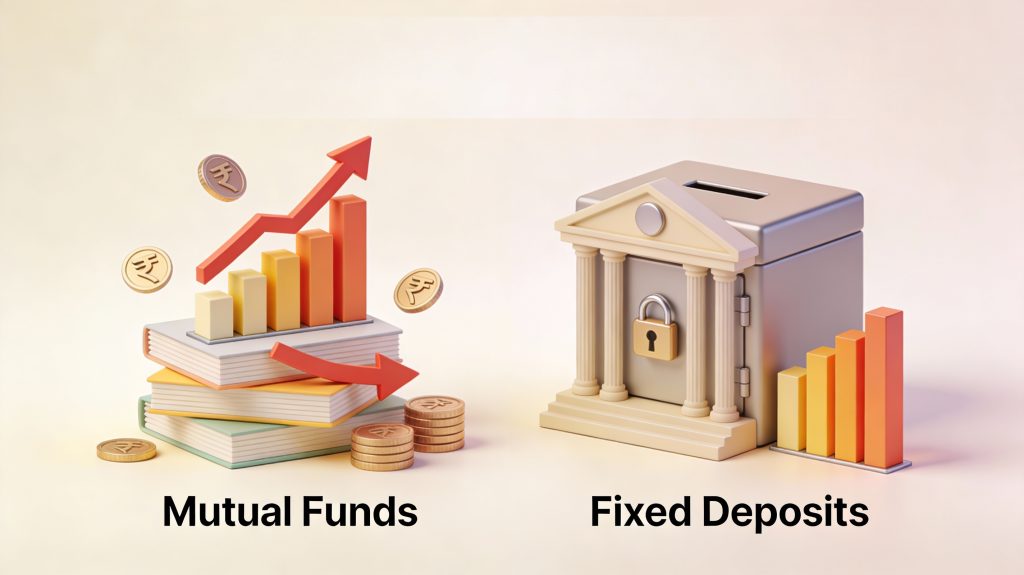
Read also:Gmail Symbols and Icons Meaning: Complete Explanation
1. Are mutual funds better than fixed deposits for beginners?
Not always. Mutual funds can offer higher long-term returns but with risk. FDs are safer and better for short-term needs or very low risk appetite. The “better” option depends on your time horizon and comfort with volatility.
2. Which is safer: mutual funds or fixed deposits?
FDs are generally safer because your capital doesn’t fluctuate if you hold till maturity and returns are fixed. Mutual funds are subject to market risk, so their value can go up or down.
3. Can I lose money in mutual funds but not in FDs?
Yes. Mutual fund values can temporarily fall below your invested amount, especially in the short term. In FDs, you normally won’t lose capital if you hold till maturity, though premature withdrawal may reduce interest.
4. How much should I invest in FDs vs mutual funds as a beginner?
Many beginners start by keeping their emergency fund and near-term goals (1–3 years) in FDs and investing a smaller portion (say 20–40%) into mutual funds for long-term goals, increasing it as they gain confidence.
5. What is the minimum amount needed to start a mutual fund SIP?
Most mutual fund houses and platforms let you start SIPs from around ₹100–₹500 per month, making it easy for students and first-time investors to begin small.
Conclusion:
- Fixed deposits (FDs), as well as mutual funds, have their uses in the financial sector.
- They provide safety, returns, and no risk, making them an attractive choice when planning for a short-term goal or unexpected emergency.
- Mutual Funds: While mutual funds have greater potential returns, they also have market-linked risks.
- “Beginners can start with a mix of both FDs and mutual funds. Beginners do not require a solo investment option, and they can start with mutual funds by maintaining some part of their
- “And as you get more experienced, you can strike a balance between safety and growth that suits you,” Gwenhebbal explained.
- So, what do you think? Let me know in the comments. And if you found this article helpful, share it with your friends.“Price is what you pay. Value is what you get.”for more such Educational News subscribe newssy.in.